HMO Fire Regulations: A Simple Guide
David Chen
January 10, 2024
HMO fire regulations catch out more London landlords than any other area of compliance. Shared housing concentrates people, cooking and electrical load into one building, and the law responds with duties reaching well beyond a couple of smoke alarms. If you let a House in Multiple Occupation you are almost certainly the "responsible person" for fire safety in the communal parts.
This guide explains what the HMO fire regulations actually consist of, what a compliant shared house tends to look like in practice, and the point most articles skate over: the exact specification for your building is set by your local council, not by a single national rulebook. Treat what follows as orientation, then confirm the detail with the borough your property sits in.
Why HMO Fire Regulations Ask More of You Than a Single Let
An HMO is, broadly, a property let to three or more people forming more than one household who share a kitchen, bathroom or WC. That definition changes the risk profile completely, and the HMO fire regulations are built around the differences.
- More ignition sources. Several tenants cooking, charging devices and running heaters multiplies the ways a fire can start.
- One shared escape route. Everyone leaves by the same stairs, so a single smoke-logged hallway can cut off several households at once.
- Unrelated occupants. People who barely know each other will not reliably wake or warn one another, so detection must do that job.
- Sleeping risk in almost every room. Nearly every room is a bedroom, which is why letting rooms are treated as fire compartments.
- High turnover. A tenant who arrived last week may not know which door is the final exit.
Enforcement reflects that. Councils inspect HMOs proactively rather than waiting for a complaint, and licensing lets them attach fire precautions to your permission to let at all, while fire and rescue authorities enforce separately. The HMO fire regulations are therefore policed by two bodies with overlapping powers, and satisfying one does not automatically satisfy the other.
Which Laws Make Up the HMO Fire Regulations?
There is no single statute called "the HMO fire regulations". The phrase is shorthand for several instruments that apply to the same property simultaneously, each enforced by a different team.
The Regulatory Reform (Fire Safety) Order 2005
The Regulatory Reform (Fire Safety) Order 2005 covers the common parts of an HMO: hallways, staircases, landings, shared kitchens, cellars and plant rooms. It requires the responsible person to carry out and keep under review a suitable and sufficient fire risk assessment, then put general fire precautions in place and maintain them. Enforcement runs from informal advice through enforcement and prohibition notices to prosecution. This Order is the backbone of the HMO fire regulations and the duty an inspector will test first.
The Smoke and Carbon Monoxide Alarm (England) Regulations
The Smoke and Carbon Monoxide Alarm (England) Regulations 2015, as amended, sit in housing law rather than fire law and apply to private lets across England, HMOs included. Within the HMO fire regulations they set a floor rather than a ceiling: meeting them does not mean your detection is adequate for a three-storey shared house.
Housing legislation and management duties
The Management of Houses in Multiple Occupation (England) Regulations 2006 place duties on the manager to keep escape routes clear and to maintain firefighting equipment and alarms in working order. Councils separately assess fire as a hazard under the Housing Health and Safety Rating System and can require works. Licence conditions add a further layer. Read together, these are the HMO fire regulations that govern a shared house day to day — our guide to HMO licensing in London covers licensing in more depth.
The Fire Risk Assessment Sits at the Heart of HMO Fire Regulations
Every other decision flows from the fire risk assessment. It identifies the hazards, the people at risk and the control measures needed, then records the actions and review dates. Councils and fire officers ask for it first, and being unable to produce one is a serious failing in itself.
A competent assessment considers layout and travel distances to a final exit, the condition of compartmentation, detection and emergency lighting provision, ignition sources such as cooking and heating, and the ability of occupants to escape unaided. It should end with a prioritised action plan, not a list of observations.
Review it whenever the building, occupancy or use changes — a loft conversion, an extra letting room or a tenant with reduced mobility all justify a fresh look. Our fire risk assessment service produces a written, actionable report, and a fire safety certificate documents the precautions once the actions are closed out.
Alarms and Detection Under the HMO Fire Regulations
Detection is where the HMO fire regulations become most visibly local, because the statutory minimum and the standard a council expects are rarely the same thing.
Where alarms must be fitted
The statutory baseline requires a smoke alarm on every storey used as living accommodation, and a carbon monoxide alarm in any room used as living accommodation containing a fixed combustion appliance other than a gas cooker. Alarms must be in working order at the start of a new tenancy, and repaired or replaced once a tenant reports a fault. Our article on smoke and carbon monoxide alarm rules works through the detail.
Testing and keeping a record
Routine testing of domestic alarms usually falls to tenants, but the landlord keeps the duty to maintain the system. Where a panelled system is installed, weekly call-point testing and periodic servicing by a competent person are the norm, and every test belongs in a fire log book. Under the HMO fire regulations, undocumented testing counts for very little at an inspection.
Fire alarm grades and categories in plain English
Specifications use the grades and categories from the British Standard for fire detection in domestic premises. The vocabulary is off-putting; the logic is not.
| Term | What it means in practice |
|---|---|
| Grade D | Mains-powered interlinked alarms with battery back-up and no control panel. |
| Grade A | A designed system with a control panel, separate detectors, manual call points and sounders. |
| LD3 | Detection in the escape routes only. |
| LD2 | Escape routes plus higher-risk rooms such as the kitchen and lounge. |
| LD1 | Detection throughout, including every letting room. |
Which combination applies depends on the size, layout and storey count of the property, on the assessment findings and on your council's published standards. Heat detectors rather than smoke detectors belong in kitchens, to avoid false alarms that tenants eventually silence. Our fire alarm installation and testing team can specify, fit and certify the system.
Fire Doors, Self-Closers and Compartmentation
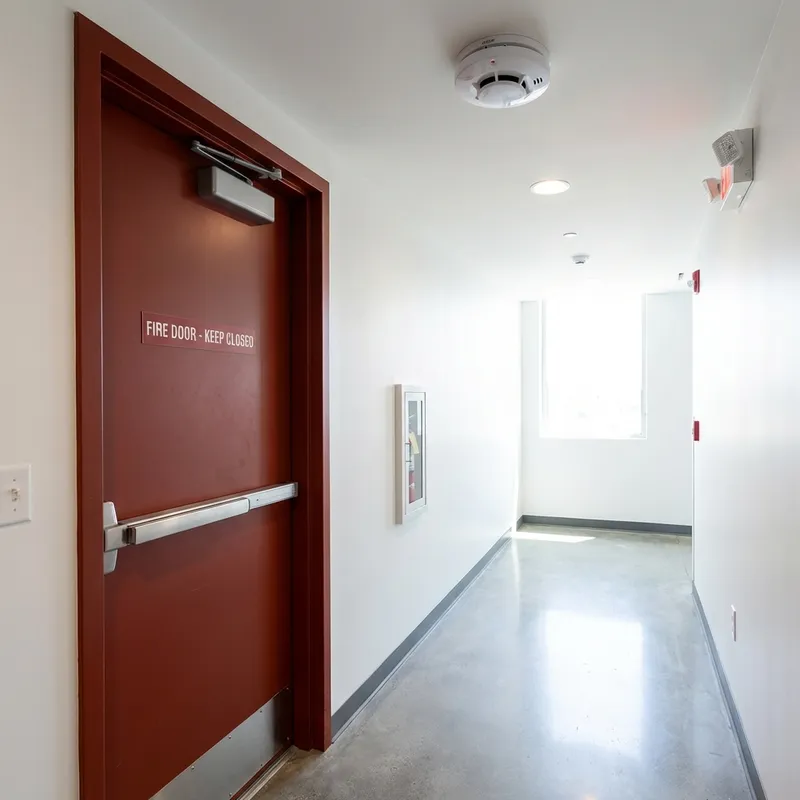
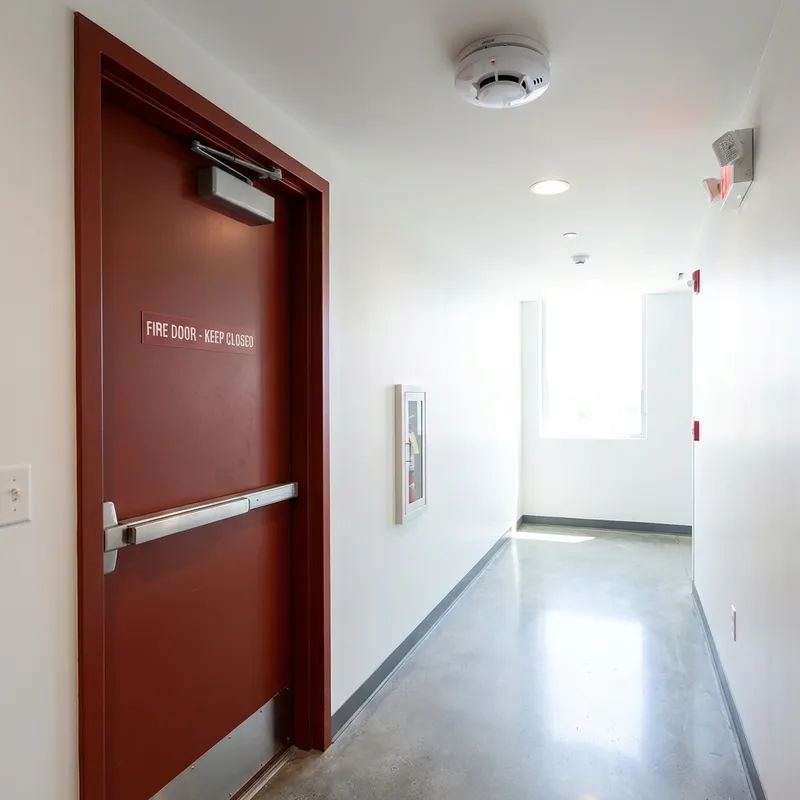
Compartmentation buys time, and it is where the HMO fire regulations bite hardest. Each letting room becomes a compartment so that a fire starting inside it is held there long enough for everyone else to reach the street.
- Fire-resisting doors. Doors onto a protected escape route are typically FD30, meaning thirty minutes of fire resistance. The rating belongs to the whole assembly — leaf, frame, seals and ironmongery — not the leaf alone.
- Intumescent strips and smoke seals. The strip expands in heat to seal the gap; the brush seal stops cold smoke passing long before that happens.
- Self-closing devices. A fire door only works closed, so the closer must shut it fully onto the latch from any angle.
- Common failures. Excessive gaps, doors cut down to clear new flooring, missing or painted-over seals, hook-and-eye latches and wedges are among the most frequent findings at inspection.
Doors need inspecting and recording, not simply installing. A fire door inspection and certificate records the condition of each door and the remedial work required, which is exactly the evidence a licensing officer asks to see.
Escape Routes, Emergency Lighting and Firefighting Equipment
The protected route from every letting room to the final exit is the single most important physical control in the building, and the HMO fire regulations treat obstruction of it seriously.
Escape routes must stay clear. Bicycles, bin bags and stored furniture on a shared staircase are among the most common enforcement findings in London, and among the easiest to fix. Final exit doors should open from the inside without a key, and nothing should be stored under a staircase forming part of the escape route.
Where a route would be dark if the power failed — windowless internal corridors, cellar stairs, larger multi-storey properties — emergency lighting is normally required. It is function-tested monthly and duration-tested annually; our emergency lighting test covers both and issues the certificate. Many councils also expect a fire blanket in each shared kitchen and extinguishers in the common parts of larger buildings, serviced annually by our fire extinguisher testing engineers.
Your Council Sets the Detail, So HMO Fire Regulations Vary by Borough
This is the part landlords most often get wrong. The HMO fire regulations state the objective — adequate detection, protected escape, maintained precautions — but rarely the specification. That arrives through your licence conditions and the standards your council publishes, and those differ from borough to borough.
Two near-identical terraced houses a mile apart, on opposite sides of a boundary, can face different alarm grades, different door requirements and different amenity standards under the same HMO fire regulations. Councils commonly work from long-established national guidance on fire safety in existing housing, but each applies it through its own published standards and licensing policy. Mandatory licensing applies across England to HMOs occupied by five or more people forming two or more households, and many London boroughs also run additional or selective schemes that pull far smaller properties in.
So before you specify anything, check the scheme covering the exact postcode on GOV.UK's house in multiple occupation licence pages, then on your own council's website, and ask for its HMO standards in writing. Assuming the HMO fire regulations are applied identically everywhere is how landlords end up refitting a house twice.
Meeting HMO Fire Regulations Without the Guesswork
Shared housing rewards a planned approach: get an honest fire risk assessment, fix what it finds, keep the certificates current and diary the recurring tests alongside your other duties. Rented homes in England need an EICR at least every five years, and breaches of the Electrical Safety Standards in the Private Rented Sector (England) Regulations 2020 carry financial penalties of up to £30,000. Gas appliances need an annual gas safety certificate, and a valid EPC is required to market the property. Our landlord safety certificates checklist pulls the programme together.
We cover London and the surrounding boroughs and can combine the assessment, alarm, lighting and door work into a single visit. Review our pricing, book your HMO fire safety visit online, or contact the team on 0208 178 4580 to talk it through first.
Frequently Asked Questions
Do HMO fire regulations require a fire risk assessment for a small shared house?
Yes. The Regulatory Reform (Fire Safety) Order 2005 applies to the common parts of any HMO, including a modest three-person share, so an assessment is required regardless of size. Only the depth of the assessment and the precautions it calls for differ.
How often should the fire alarm in an HMO be tested?
Your fire risk assessment sets the regime. Where a panelled system is installed, weekly call-point testing plus periodic servicing by a competent person is the usual pattern, with every test logged. Domestic interlinked alarms are tested far more informally, but the landlord still has to keep them working.
Does every door in an HMO have to be a fire door?
Not necessarily. The usual expectation is that doors opening onto the protected escape route, and doors to higher-risk rooms such as kitchens, are fire-resisting and self-closing. Your assessment and your licence conditions should identify precisely which doors need upgrading.
Who is legally responsible for fire safety in an HMO?
The "responsible person" is whoever has control of the premises — normally the landlord, or the managing agent where one is appointed. Delegating the work does not remove your duties under the HMO fire regulations, so agree in writing who arranges each inspection, test and certificate.
This article is general guidance for landlords in England and is not legal advice. Requirements change and the detailed standards vary by borough — confirm the current position on GOV.UK and with your local authority, and take professional advice on your own property.
About the Author
David Chen
Senior Compliance Officer
Specializing in UK property law and safety regulations with over 15 years of experience in the London market.